|
|
| |
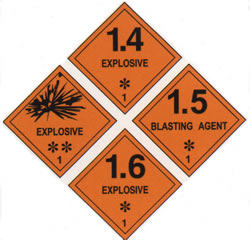
Division 1.1 - Explosives whose mass
explosion hazard affects the entire load instantaneously.
|
|
Division 1.2 - Explosives
with a projection hazard, but not a mass explosion
hazard.
|
|
Division 1.3 - Explosives
with a fire hazard along with a minor blast hazard and a
minor projection hazard, but not a mass explosion hazard.
|
|
Division 1.4 - Explosives
that present a minor explosion hazard that is largely
confined to the package without projection of fragments
of appreciable size or range and in which an external
fire would not cause instantaneous explosion of the
whole package.
|
|
Division 1.5 - Insensitive
explosives comprised of substances with a mass explosion
hazard with minor probability of initiation or
transition from burning to detonation under normal
conditions of transport.
|
|
Division 1.6 - Insensitive
articles without a mass explosive hazard, but contain
insensitive detonating substances and demonstrate a
negligible probability of accidental initiation or
propagation.
|
|
Class 2: Gases
|
| |
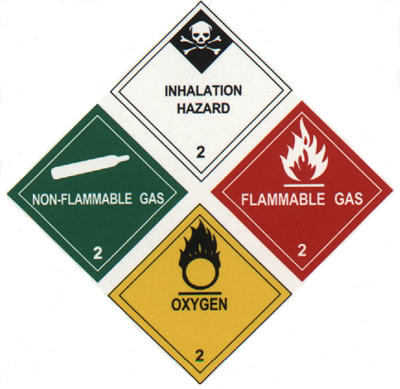
Division 2.1 -
Flammable gas is at 20°C (68°F) or less and 101.3 kPa (14.7
psia) of pressure and can ignite when in a mixture of 13
percent or less by volume with air or has a flammable range
with air of at least 12 percent regardless of the lower
limit. |
|
Division 2.2 -
Non-flammable, nonpoisonous compressed gas, which is any
material (or mixture) that exerts in the packaging an
absolute pressure of 280 kPa (40.6 psia) or greater at 20 °C
(68 °F) and does not meet the definition of Division 2.1 or
2.3. |
|
Division 2.3 -
Gas poisonous by inhalation is at 20°C (68°F) or less and a
pressure of 101.3 kPa (14.7 psia) and is known to be toxic
to humans so as to pose a hazard to health during
transportation. |
|
Class 3: Flammable Liquid
|
| |
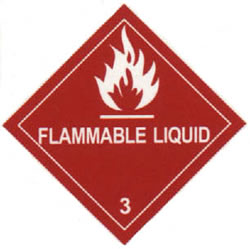
Flammable liquid has a flash point
of not more than 60.5°C (141°F) or any material in a
liquid phase that has a flash point at or above 37.8°C
(100°F) that is intentionally heated and offered for
transportation or transported at or above its flash
point in a bulk packaging.
|
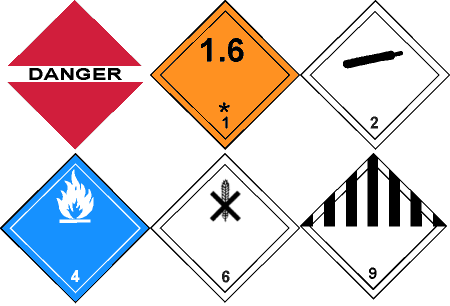
| Class 4:
Flammable Solid, Spontaneously Combustible, and Dangerous
When Wet |
|
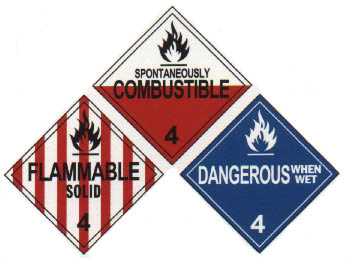 |
Division 4.1
- Flammable Solid is any of these three types of
materials:
- Desensitized explosives that
when dry are explosives of Class 1 and are specifically
authorized by name or have been assigned a shipping name
and hazard class by the Associate Administrator.
- Self-reactive materials,which
are thermally unstable and that can undergo a strongly
exothermic decomposition even without participation of
air.
- Readily combustible solids that
can cause a fire through friction and show a burning
rate faster than 2.2 mm (0.087 inches) per second, or
metal powders that can be ignited and react over the
whole length of a sample in 10 minutes or less.
|
| Division 4.2
- Spontaneously Combustible material is a pyrophoric
material, which is a liquid or solid that can ignite within
five (5) minutes after coming in contact with air or a self-heating
material that when in contact with air and without an energy
supply is liable to self-heat. |
| Division 4.3
- Dangerous When Wet material is a material that when
it makes contact with water is liable to become
spontaneously flammable or give off flammable or toxic gas
at a rate greater than 1 L per kilogram of the material per
hour. |
|
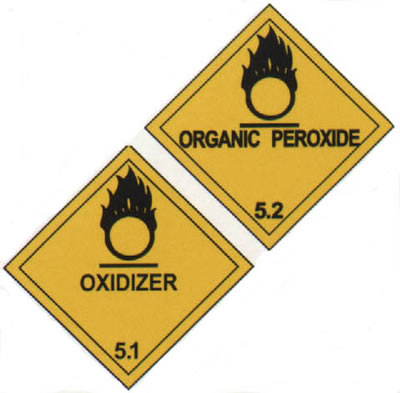
Class 5: Oxidizer, Organic
Peroxide
|
|
|
Division 5.1
- Oxidizer is a material that can (generally by
yielding oxygen) cause or enhance the combustion of other
materials. |
| Division 5.2
- Organic Peroxide is any organic compound containing
oxygen (O) in the bivalent -O-O- structure and that can be
considered a derivative of hydrogen peroxide. |
|
Class 6: Poison,
Poison Inhalation Hazard, Infectious Substance |
|
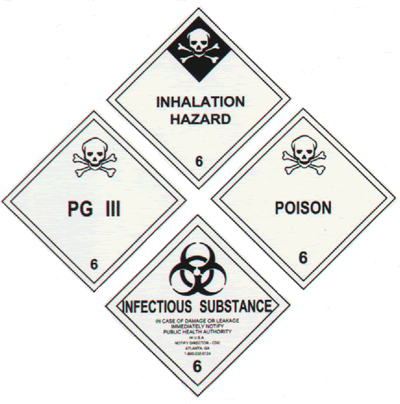 |
Division 6.1
- Poisonous Material is a material, other than a gas,
that is:
- known to be toxic to humans so
as to afford a hazard to health during transportation or
is presumed to be toxic to humans because it falls
within a toxic category when tested on laboratory
animals.
- an irritating material such as
tear gas that causes extreme irritation, especially in
confined spaces.
|
| Division 6.2
- Infectious Substance material is known to contain or
suspected of containing a pathogen. |
|
Class 7: Radioactive |
|
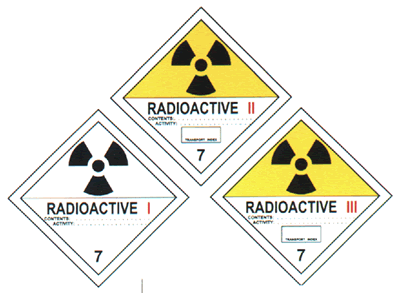 |
Radioactive
material is fissile material such as plutonium-238,
plutonium-239, plutonium-241, uranium-233, uranium-235, or
any combination of these radionuclides. The definition does
not apply to unirradiated natural uranium and depleted
uranium, and natural uranium or depleted uranium that has
been irradiated in a thermal reactor. |
|
Class 8: Corrosive |
|
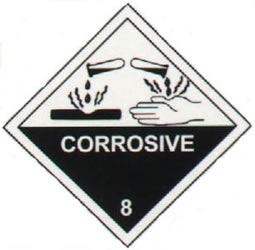 |
Corrosive material
is a liquid or solid that causes destruction of human skin
at the site of contact within a specified period of time or
a liquid that has a severe corrosion rate on steel or
aluminum. |
|
Class 9: Miscellaneous Hazardous Material |
|
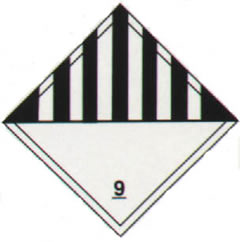 |
Miscellaneous
hazardous material is a material that presents a hazard
during transportation, but does not meet the definition of
any other hazard class. |